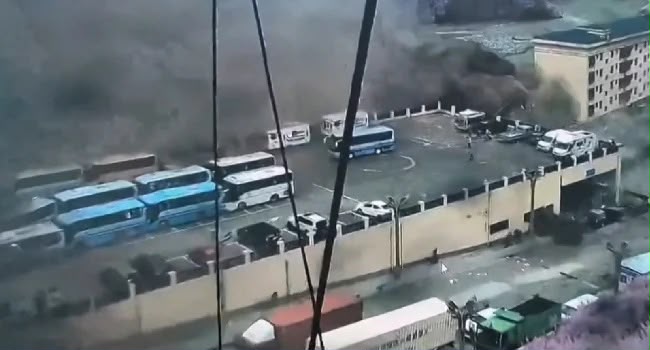
A catastrophic flash flood along the Nepal-China border has killed at least 160 people and left hundreds more missing after a powerful surge of water, ice, rock and debris swept through communities in the Himalayan region.
The disaster struck Wednesday, August 26, after part of a glacier in the high Himalayas collapsed, sending an enormous mass of ice and rock into a river system near the Nepal-Tibet border. The resulting surge caused devastating flooding across parts of Nepal and Tibet, destroying homes, roads, bridges and other critical infrastructure.
Nepalese authorities have recovered at least 157 bodies, while officials in Tibet have reported three additional deaths. The number of missing people has continued to change as authorities attempt to account for residents, workers and travelers caught in the disaster.
A particularly large number of foreign nationals are among those unaccounted for. Authorities have reported missing tourists and travelers from countries including India, the United States, Britain, Australia, Malaysia, Canada and South Korea. Some were reportedly traveling through the region toward Mount Kailash and other Himalayan destinations.
The flooding struck areas around the Bhote Koshi and Trishuli river systems, with the Rasuwa district among the hardest-hit areas in Nepal. Villages were inundated and sections of roads and bridges were swept away, while power and communication infrastructure was also damaged.
The cause of the disaster was initially uncertain, with early reports suggesting that an earthquake may have triggered the event. Subsequent analysis by the U.S. Geological Survey indicated that the seismic signal was generated by the massive landslide itself rather than by an earthquake. Scientists said a section of glacier collapsed at high elevation, plunging into the valley and gathering rock and sediment before triggering the destructive flood.
Rescue teams from Nepal and China are continuing efforts to locate survivors and recover those still missing. Difficult terrain, heavy sediment, damaged roads and disrupted communications have complicated the operation.
Nepalese authorities have warned people living downstream to remain away from riverbanks because of continuing risks associated with unstable terrain and possible additional flooding. Emergency agencies are also working to assess damage and provide assistance to displaced residents and travelers.
The disaster has caused widespread destruction in an area already known for its steep Himalayan terrain and difficult access. Images and footage from the affected region have shown homes surrounded by mud and debris, damaged infrastructure and rivers swollen far beyond their normal channels.
International assistance is also beginning to reach the affected region, with neighboring countries and international organizations offering support for rescue and relief operations. The United Nations and other agencies have indicated that assistance is being mobilized as authorities assess the scale of the catastrophe.
For families across Nepal and neighboring Tibet, the disaster has brought devastating uncertainty as they wait for information about relatives who remain missing. The presence of hundreds of tourists and foreign workers among those unaccounted for has also prompted governments and diplomatic missions to work with local authorities to determine the whereabouts of their citizens.
The full scale of the tragedy may not be known for some time. Rescue crews are still searching affected areas, while authorities continue identifying recovered victims and compiling lists of people who remain missing.
The Nepal flash floods have become one of the region’s most devastating recent natural disasters, leaving communities facing deaths, displacement and enormous infrastructure damage.
As search-and-rescue operations continue, families are holding onto hope that more survivors can be found while emergency workers confront dangerous conditions in the flood-hit Himalayan region.